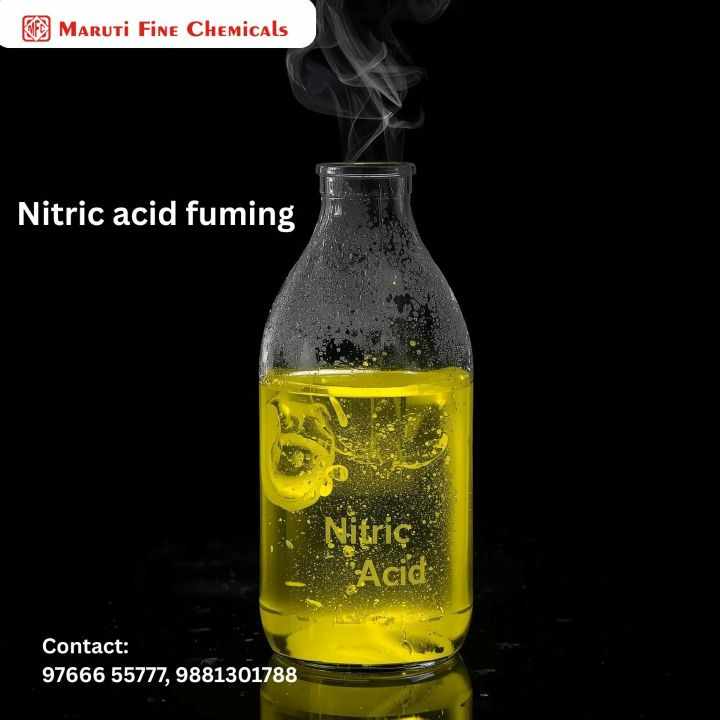
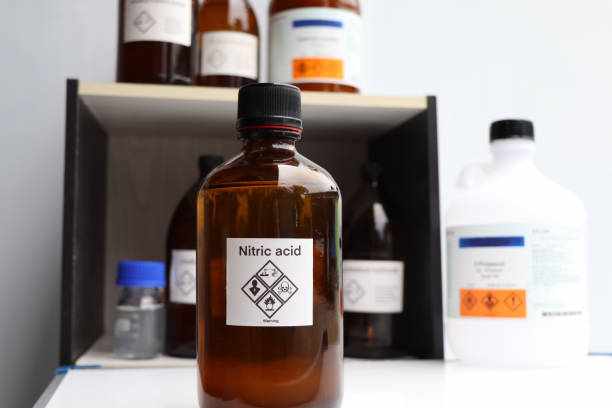
Nitric acid fuming 98% is an ultra-concentrated grade of nitric acid (HNO₃) containing minimal water and extremely high oxidising power. Because of its high purity and reactivity, it’s widely used in advanced chemical synthesis, nitration, oxidation, and refining processes.
This grade, also known as white or red fuming nitric acid, emits visible nitrogen dioxide (NO₂) vapours due to the presence of dissolved nitrogen oxides. Its density is typically around 1.50 g/cm³, and its low water content makes it far more aggressive and reactive than standard nitric acid.
At Maruti Fine Chemicals, we supply high-purity fuming nitric acid 98% to ensure maximum yield, consistent performance, and reliable supply for industrial users who need precision and safety.
Q2. Why do industries prefer Nitric Acid Fuming 98% over standard nitric acid?
The key lies in performance. Standard nitric acid (60–70%) contains significant water, which can cause side reactions or reduce nitration efficiency. By contrast, Nitric Acid Fuming 98% offers ultra-high concentration, improving selectivity and yield in nitration and oxidation reactions.
Applications include:
Nitration of aromatic compounds
Production of high-energy materials and specialty organics
Metal purification and etching
Research and fine-chemical synthesis
In processes where every fraction of yield matters, switching to fuming nitric acid 98% reduces water interference and delivers cleaner, faster reactions.
Q3. Is handling Nitric Acid Fuming 98% risky?
Yes — it’s a highly corrosive and reactive acid. That’s why Maruti Fine Chemicals provides complete safety documentation, technical guidance, and compliant packaging under UN2031 classification.
Storage and handling require:
Inert, moisture-free containers
Corrosion-resistant tanks
Proper ventilation and fume control systems
Personal protective equipment (acid-resistant gloves, goggles, face shields)
Our logistics and safety team ensure every delivery meets global safety and regulatory standards. With us, you get high performance — without the hazard headaches.
Q4. What exactly is Fuming Sulphuric Acid, and how does it differ from regular H₂SO₄?
Fuming Sulphuric Acid, also known as Oleum, is sulfuric acid saturated with sulfur trioxide (SO₃). This dissolved SO₃ gives it extreme reactivity and the characteristic white fumes when exposed to air or moisture.
While regular sulphuric acid (98%) is already strong, fuming sulphuric acid is far more powerful in dehydration and sulfonation. It drives reactions that standard H₂SO₄ cannot, making it vital in:
Sulfonation of dyes, detergents, and specialty chemicals
Dehydration reactions in pharmaceuticals and intermediates
Petrochemical refining and advanced material synthesis
Maruti Fine Chemicals supplies oleum in controlled, moisture-free packaging with clear technical specifications and COAs for safe use and predictable results.
Q5. What makes Fuming Sulphuric Acid “fume”?
The “fuming” effect occurs because of the high SO₃ content. When exposed to air, SO₃ reacts with moisture, releasing white vapours — a clear indicator of its reactive nature. This intense reactivity allows Fuming Sulphuric Acid to act as a strong dehydrating and sulfonating agent.
It’s indispensable for industries that demand ultra-high reaction strength and efficiency. However, this same reactivity requires strict handling and proper safety measures — something Maruti Fine Chemicals is well-equipped to support.
Q6. How do Nitric Acid Fuming 98% and Fuming Sulphuric Acid complement each other?
These two reagents are often used together in advanced chemical reactions. For instance:
In nitration chemistry, a mixture of fuming nitric acid 98% and fuming sulphuric acid (oleum) is used to achieve superior nitration of aromatic compounds.
Nitric acid provides the nitrating strength, while sulphuric acid acts as the dehydrating medium that enhances reaction efficiency.
This combination is common in industries producing dyes, explosives, pharmaceuticals, and fine chemicals. Procuring both reagents from Maruti Fine Chemicals ensures consistent purity, simplified logistics, and uniform performance across your processes.
Q7. What are the safety standards followed by Maruti Fine Chemicals?
We operate under strict quality, safety, and regulatory frameworks.
Quality control: Every batch of Nitric Acid Fuming 98% and Fuming Sulphuric Acid is tested for purity, water content, and corrosive behaviour.
Documentation: Certificates of Analysis (COA) and Safety Data Sheets (SDS) are provided for every supply.
Packaging: We follow UN packaging norms for high-hazard acids — UN2031 for fuming nitric acid, and packing group I compliance for fuming sulphuric acid.
Regulations: Our operations comply with chemical import/export and transport safety standards, ensuring worry-free supply to industrial clients.
When you buy from Maruti, you’re not just getting a product — you’re getting assurance.
Q8. How can these reagents improve manufacturing efficiency?
Using Nitric Acid Fuming 98% and Fuming Sulphuric Acid can dramatically improve:
Reaction yield: Higher concentration means fewer impurities and side-products.
Selectivity: Cleaner reaction pathways, especially in nitration and sulfonation.
Throughput: Shorter reaction times and better conversion rates.
Process safety: Consistent reagent quality reduces unexpected reactions.
Even though the upfront cost is higher, the long-term gains in productivity, purity, and reduced downtime easily justify the investment.
Q9. What should manufacturers consider before switching to fuming-grade acids?
A practical guide:
Assess process limitations: Are you facing low yields or side reactions with standard acids?
Match reagent to process: Use Nitric Acid Fuming 98% for nitration/oxidation and Fuming Sulphuric Acid for sulfonation/dehydration.
Ensure equipment compatibility: Reactors, pipelines, and valves should be made of corrosion-resistant materials (glass-lined steel, PTFE, or special alloys).
Plan for safety: Install fume scrubbers, PPE protocols, and emergency wash stations.
Source from experts: Maruti Fine Chemicals provides not only the acid but also safety training, compliance, and handling guidance.
Q10. How should Nitric Acid Fuming 98% and Fuming Sulphuric Acid be stored?
Storage best practices:
Keep in cool, dry, well-ventilated areas away from organic matter and moisture.
Use sealed, corrosion-resistant containers.
Label storage clearly and isolate from incompatible materials.
Conduct periodic inspection of drums or tanks for corrosion or leakage.
At Maruti Fine Chemicals, our packaging ensures the acids remain stable during transport and long-term storage.
Q11. Are these reagents environmentally safe to use?
Both acids are classified as high-hazard materials. Proper handling ensures minimal environmental impact. Spent acids must not be diluted directly; they require neutralisation or regulated disposal as per environmental guidelines.
Maruti Fine Chemicals provides support documents and recommendations for waste management and neutralisation to help clients meet environmental compliance goals.
Q12. What are the most common industries using Nitric Acid Fuming 98% and Fuming Sulphuric Acid?
These reagents are essential across high-performance sectors:
Specialty chemicals and dyes
Pharmaceutical intermediates
Petrochemicals
Metallurgy and etching
Explosives and propellants
Research laboratories and fine chemical synthesis
Because of their purity and strength, they are also used in advanced materials like carbon nanotubes, semiconductors, and energy materials.
Q13. What technical support does Maruti Fine Chemicals offer?
We’re not just a supplier — we’re a technical partner. Our team provides:
Handling and storage guidance
Compatibility checks for materials and equipment
Optimisation advice for reaction efficiency
Documentation for compliance and audits
Our expertise helps clients avoid costly mistakes and ensures safe, efficient integration of these reagents into their processes.

Q14. How does Maruti Fine Chemicals maintain quality and reliability?
High-purity sourcing: Only verified raw materials and controlled distillation processes.
Batch testing: Every lot of fuming nitric acid and oleum is lab-tested before dispatch.
Reliable logistics: Expert handling of corrosive cargo with trained staff and compliant vehicles.
Consistent supply: We maintain strong inventory levels to support continuous industrial operations.
With Maruti Fine Chemicals, you get a dependable partner who understands the chemistry, the risks, and the performance your business demands.
Q15. How are these reagents driving future chemical innovation?
The demand for Nitric Acid Fuming 98% and Fuming Sulphuric Acid is growing because industries now require cleaner, faster, and more sustainable processes. Advanced manufacturing in pharmaceuticals, specialty intermediates, and materials science relies heavily on precise, high-energy reactions that only fuming-grade acids can deliver.
As global regulations tighten and efficiency expectations rise, companies are turning to trusted chemical partners like Maruti Fine Chemicals for reliable, compliant, and high-performance reagent supply.
Q16. What are some tips for optimising results when using these reagents?
Monitor feed quality: Ensure raw materials are dry and contaminant-free.
Control temperature: Both acids produce exothermic reactions; maintain cooling.
Use corrosion-resistant setups: Avoid leaks and extend equipment lifespan.
Ensure fume scrubbing: Capture NO₂ and SO₃ vapours safely.
Train operators regularly: Handling fuming acids demands periodic safety refreshers.
Following these best practices improves consistency and keeps operations safe.
Q17. What questions should you ask before choosing a supplier?
Ask for:
COA and SDS documentation
Packaging type and UN certification
Delivery schedule and consistency record
Handling support and training availability
Experience in dealing with high-hazard reagents
Maruti Fine Chemicals meets all these benchmarks, ensuring clients get both top-grade chemicals and expert support.
Q18. Why should I choose Maruti Fine Chemicals over others?
Because we specialise where others generalise.
Expertise: Focused on high-performance reagents like Nitric Acid Fuming 98% and Fuming Sulphuric Acid.
Safety-first approach: UN-certified packaging, safety compliance, and technical support.
Reliability: Timely delivery, consistent purity, and documented quality assurance.
Partnership mindset: We work with you to fine-tune your process, not just sell chemicals.
Our clients value us for our precision, transparency, and deep technical know-how.
Q19. What’s the long-term advantage of using fuming-grade acids?
Efficiency and precision. By integrating Nitric Acid Fuming 98% and Fuming Sulphuric Acid, industries achieve higher yield, cleaner reactions, and reduced waste. Over time, that translates into cost savings, improved sustainability, and a competitive edge in production quality.
Q20. How can you start sourcing from Maruti Fine Chemicals?
It’s simple — contact our team for specifications, pricing, and safety documents. We’ll guide you through product selection, logistics, and integration based on your application.
Get in touch with Maruti Fine Chemicals today to secure your supply of Nitric Acid Fuming 98% and Fuming Sulphuric Acid — precision-grade reagents that power the next generation of high-performance chemistry.
visit here-https://www.indiamart.com/proddetail/fuming-nitric-acid-11322631633.html?sellerpreview=1


Write a comment ...